Friday, December 14, 2012

Reply to The Toronto Star: Why Do People Hate Him (Justin Bieber) So Much?

In its article dated December 13, 2012, the Toronto Star was asking why do people hate Justin Bieber. That came following the revelation of a plot to murder (!) Bieber.

Finally an interesting question to ponder with.

I’ll start by saying that the plot to murder Mr. Bieber is insane, backward, unacceptable and is a terrible thing to read about. While I certainly am not Justin Bieber’s fan – not even in the slightest – it doesn’t matter what you think about the person and/or the music he is performing, plotting to murder the youngster is just plain wrong. I hope the people who were charged with this will be brought to trial, and if found guilty, will receive the maximum punishment allowed by Ontario’s law.

As I wrote above, I am not a fan of Justin Bieber’s music. With regards to Bieber’s person, I can’t say I hate him (or love him) for the mere fact that I don’t know him. As a matter of fact, I consider prying into strangers’ personal lives – whether they are celebrities or not – as an excellent exercise in wasting precious time.

Still, I have my own opinion as to why Bieber is so disliked. My opinion is that there are a few reasons for this, most of which have nothing to do with Bieber’s personality.

Reason 1: The Person

No, driving a $100,000 car through the streets of Los Angeles doesn’t (or at least shouldn’t) render Bieber a subject of hate. Jealousy? maybe. Hate? definitely not.

People who hate Bieber because of his wealth are living in denial. Luck has it upon our society and we live in a capitalist one. Bieber rides his vehicle and treats it exactly the same way that I treat my 1998 Honda Accord, or the way that you treat your 2008 Ford Focus. $100,000 for Bieber is what $50 are to you and me. It’d be safe enough to assume that, of those who hate Bieber because of his wealth, I could find close to zero who would refuse being as rich as Bieber is.

So yes, it is OK to be jealous. Most people in the world would have liked the idea of not having to work 9 to 5 jobs for the sake of survival; but it is what it is. Whoever you are, there’s someone else who’s richer than you are, and if not – then there’s some else who aspires to be as rich as you are. But to actually hate the guy for his wealth? give me a break.

That being said, disrespect may be in order. On that front, I can’t help but reminiscing over Viktor Frankl’s immortal “Man’s Search for Meaning”, where he claims that freedom and responsibility go hand in hand. People would respect Bieber much more, had he put his immense financial & influential resources towards good use. And no, replying over Twitter to someone about supporting organ donations is not enough; neither is supporting all sorts of charities.

We’d prefer to see Bieber to more than just saying “OK” to his PR folks when they ask him whether he’s interested in donating to a certain charity. We’d prefer to see some active, personal involvement for good cause. Bieber is 18 years old, with his entire life in front of him; now is the time to be personally involved in something good for humanity’s sake, in a way that risks a bit more than his chequebook.

Other people claim they “hate” Justin Bieber because he has a negative impact on culture. This I’m not sure I agree with. Many decades ago, The Beatles weren’t welcome in the USA for this very same reason. What seems like “negative impact” today, may as well be perceived as “positive impact” years from now. It is too early, in my opinion, to judge Bieber’s case at the moment.

Reason 2: The Music Industry & Dehumanization

This one has little to do with Bieber’s personality, and has everything to do with the music industry.

Something terrible is going on with the music industry as a whole, which can be explained by the very existence of this very term, “music industry”. Music became an industry. Not that it wasn’t an industry before, of course; but still, you have to be living under a really heavy rock in order to not realize that the race towards money and fame seems to drive more artists nowadays than it did 50 years ago.

Can you seriously compare today’s Justin Bieber; or the various sorts of gangster-wannabe rappers; or the forcibly-provocative figures such as Nicki Minaj; or the forcibly-extravagant of… well, too many names I could place here and I prefer to insult them all equally so I’ll avoid naming names – can you compare those to Bob Dylan? John Lennon? Mark Knopfler (well, you saw this one coming, didn’t you)? Robert Plant? Freddie Mercury? Eddie Vedder? Pink Floyd?

You can’t. It’s not that the latter group isn’t (or wasn’t) popular. It’s simply that the latter group is a group of musicians, and the former group (Bieber et al) are a group of PR machines.

Can you compare any of Justin Bieber’s lyrics to, say, this?

The captain, barely breathing, kneeling at the wheel
Above him and beneath him fifty thousand tons of steel
He looked over at his compass, and he gazed into its face
Needle pointing downward, he knew he lost the race

In the dark illumination he remembered bygone years
He read the Book of Revelation, and he filled his cup with tears
When the Reaper's task had ended, sixteen hundred had gone to rest
The good, the bad, the rich, the poor, the loveliest and the best

(from Bob Dylan’s “Tempest”, 2012)

The above is not even an old song. It’s brand new, 2012, from Dylan’s last album “Tempest”, telling in an extraordinarily beautiful words the story of the Titanic sinking.

I think you see my point already. The popularity of musicians today – much of which is controlled by the media – is very loosely correlated to those musician’s actual contribution to the music world. Neither Bieber, nor Minaj, nor Lady Gaga, nor… well, nor pretty much any “current” PR machine could never, ever, exhibit even a tad of Dylan’s songwriting skills.

So what’s happening here? there’s a group of people – who, personality-wise, might otherwise be really great, who knows – who are being nicely wrapped by money-making PR businesses who dehumanize them and provide them to us, the music consumers, as products. We’re having the product shoved into our faces (and our ears), touting the product’s worthiness based on criteria that has nothing to do with music (for example: being handsome; being sexy; being sensational; being rich) – and that’s when the Halo Effect and Attribute Substitution kick in.

The Halo effect and Attribute Substitution are two psychological phenomena that are so profoundly common that I can hardly imagine any PR machine not basing itself upon them. Read about them and you should be able to figure things out.

I guess that what I’m saying is, that the mass disrespect towards Bieber might actually have something to do with the fact that the amount of PR attention that he receives is completely and utterly disproportional to his contribution to culture in general, and music in particular.

Reason 3: Reward for Hard Work?

Most people still associate “reward” with “hard work”. Be honest with yourselves: who amongst us hasn’t been told repeatedly during their childhood years, that good things come to those who work hard? that reward and hard work are intertwined and inseparable?

It can be understood, then, why most people exhibit a fair bit of frustration when they witness that there are exceptions to this rule. In that respect, there isn’t much difference between the disrespect people feel towards Bieber and the disrespect certain people feel towards the Royal Family, for example. I admit to belong to that group: while I am not in the position where I struggle for my existence, I still find it frustrating, at times, to witness people getting rewarded for doing very little.

We encounter such frustration whenever we identify a gap between someone’s perceived intrinsic value and their reflected value. In other words, we tend to exhibit negative feelings towards people who we perceive as having put very little effort into being successful, and at the same time being extraordinarily rewarded for it.

That, however, isn’t Bieber’s problem. The world is ever-changing; values that used to hold true before, aren’t necessarily holding true nowadays. In today’s day and age, reward and hard work aren’t tightly correlated as before. You really don’t need much intrinsic value to become rewarded, especially when you correlate “reward” with “money”. To become rich, you don’t necessarily have to work hard – at least not as hard as you’d have to work 30 or 40 years ago.


Signing off this post while Bob Dylan’s “Tempest” still rings in my ears.

Isaac

Tuesday, November 20, 2012

War, 2012

I am writing this while sitting in my apartment’s solarium. The view from the 27th floor (well, it’s actually the 23rd floor, considering the fact that there are no floors numbered 4, 13, 14 and 24. The number “4”, in Chinese, rhymes with the word “death”) is spectacular. Mostly cloudy; it rained for a very short while, and the sun is now making an appearance somewhere, casting some light over the city.

It looks something like this:

P1050405

It has been a very rough week. My entire family, and most of my friends, live in Israel. Unless you have been living under a rock over the last week or so (and if you did – I envy you), you are most likely aware of the fact that last week, after 12 years during which rockets have been fired by the Islamo-fascist regime called Hamas (along with its partners, carrying names such as Islamic Jihad and so on) onto towns in southern Israel, the government of Israel decided (finally) that the situation doesn’t make any sense and started Operation Pillar of Cloud.

The entire worldwide attention suddenly shifted around in an amazing pace. As soon as the operation started (by obliterating Hamas’ chief of staff, Ahmed Jabari, who, in 1998, ordered his soldiers to open fire at an Israeli school bus), the 30,000+ casualties in Syria – murdered by Syria’s own administration – didn’t matter anymore; world hunger, other worldwide conflicts, the limping worldwide economy – all of these simply vanished off the radar, and the entire world turned its attention to Israel, the Neighbourhood Bully, who has decided to take on the indescribably-unacceptable act of protecting its own citizens.

One day after the operation started, rockets – fired by Hamas – hit central Israel for the first time (just for providing the unaware reader with some proportions, “central Israel” is located 80km away from Gaza. That’s about 50 miles. Here, this might help).

Even though the governments of Israel over the years have made it a norm for its southern residents to live under rocket fire for 12 years – yes, there’s no typo here; 12 years. That’s how twisted Israeli politics can get – still, a mental barrier shattered to pieces once rockets started hitting Tel-Aviv. That, considering the fact that the current Israeli government is the most right-winged government in Israel’s 64 years of existence.


“Religion is what keeps the poor from killing the rich”
   - Napoleon Bonaparte

The social media, of course, wasn’t left behind. I have spent hours doing my best to defend Israel’s position in various forums and threads, with very mixed results.

Here is what I have learned:

  • Individuals who base their opinion solely on what they hear in the media are very unlikely to have any sort of perspective. That is true regardless of how developed is the economy where such individuals live; this seems to be some sort of a global truth.
  • It is virtually impossible to have Islamo-fascists (and their supporters) take any sort of responsibility over the repercussions of terrorism acts. That, again, has very little to do with where these people live. As a matter of fact, one of the most twisted-minded individuals I had the misfortune to discuss with happened to be a Canadian, living right across the bridge in North Vancouver.
  • The interpretation people provide to religion – any religion – has always been, and is most likely bound to always be, the number one reason for warfare. This is especially true for monotheistic religions, where “my God is true, yours is garbage” is not an uncommon value.
  • I don’t have enough brainpower to cope, conversationally, with people who lack the sense of personal, and communal, responsibility. Such people I am simply allergic to.

And finally, to my Israeli friends, this one is for you:

There is, unfortunately, very little point in trying to use social media to convince others that you are correct when it comes to Islamo-fascism. Even if there is a point, the methods in which you’re trying to convince others are rather pointless:

  • Those who already understand the dangers of Islamo-fascism don’t require convincing in the first place.
  • Those who already bought into Islamo-fascism, didn’t buy into it based on proper research and independent, critical thinking. They bought into it as a result of being brainwashed – either by mass media, family, friends, you name it – and your arguments are very unlikely to change that.
  • A true Islamo-fascist will never admit any wrongdoings of Islamo-fascist regimes.
  • (This one is important) Those who are undecided, but haven’t yet bought into Islamo-fascism, have already demonstrated their ability to withstand the pressures of mass media and superficial allegations. They aren’t impressed by all sorts of pointless images and tables, showing graphs of rockets being fired by each side. Just as they didn’t buy into graphs, tables and images spread by Islamo-fascism, they aren’t going to react to graphs, tables and images spread by Israel’s supporters.

    That is not the way to do it.

    So how this should be done? Here:
    • Class up. Don’t bring yourselves down to the level of those whose wrongdoings you want highlighted. Control your temper.
    • ALWAYS present facts.
    • DON’T confuse facts with fiction.
    • AVOID, to the greatest extent possible, presenting opinions. This is the key issue here: people who have the ability for critical thinking simply don’t buy into attempts of others to influence their thinking. Present the facts to them, and have them reach the conclusions themselves.
    • Read the last bullet again loudly. Sip, rinse, spit.

It’s 4:40pm now. Starting to get a little dark. The BC Place, located right in front of my apartment, is starting to show some colors:

P1050410

It’s a pretty sight.

Soon, I will head over to a nearby coffee place and continue working on the music score for something I have been working on, for a while. If it wasn’t for rockets flying over the heads of so many people I care for, I would have said that life is just about perfect at the moment.

Isaac

Thursday, November 15, 2012

80km from Anywhere (Almost)

Some of my friends might be listening to the news in their home countries and hear that Israel, “once again”, “overreacts”.

80km

To help my friends get some perspective, I went through my Facebook friends list and, using http://www.freemaptools.com, created some links to help understand what 80km means.

Why 80km? 80km is the range of missiles fired from Gaza into Israel.

How to use this table: find a city near you, and click the link beside you. Imagine you live in that city, and rockets are fired at you from any point within the green circle. Conversely, imagine that rockets are fired from the center of the green circle, and your house is anywhere within that circle.

Overreacting, huh?

(I have close to 300 friends, from many places around the world; naturally, I didn’t cover everything. But this should give you some idea)

Europe

City

Link

Delft, The Netherlands http://www.freemaptools.com/radius-around-point.htm?clat=52.009507&clng=4.360514999999964&r=80&lc=FFFFFF&lw=1&fc=00FF00
Norwich, UK http://www.freemaptools.com/radius-around-point.htm?clat=52.630886&clng=1.2973550000000387&r=80&lc=FFFFFF&lw=1&fc=00FF00
Dagenham, UK http://www.freemaptools.com/radius-around-point.htm?clat=51.53889&clng=0.14742999999998574&r=80&lc=FFFFFF&lw=1&fc=00FF00
Lyon, France http://www.freemaptools.com/radius-around-point.htm?clat=45.764043&clng=4.835658999999964&r=80&lc=FFFFFF&lw=1&fc=00FF00
Dalfsen, The Netherlands http://www.freemaptools.com/radius-around-point.htm?clat=52.507755&clng=6.259667000000036&r=80&lc=FFFFFF&lw=1&fc=00FF00
Paris, France http://www.freemaptools.com/radius-around-point.htm?clat=48.856614&clng=2.3522219999999834&r=80&lc=FFFFFF&lw=1&fc=00FF00
Prague, Czech Republic http://www.freemaptools.com/radius-around-point.htm?clat=50.075538&clng=14.437801000000036&r=80&lc=FFFFFF&lw=1&fc=00FF00
Sofia, Bulgaria http://www.freemaptools.com/radius-around-point.htm?clat=42.696492&clng=23.326010999999994&r=80&lc=FFFFFF&lw=1&fc=00FF00
Stockholm, Sweden http://www.freemaptools.com/radius-around-point.htm?clat=59.32893&clng=18.064910000000054&r=80&lc=FFFFFF&lw=1&fc=00FF00
Helsinki, Finland http://www.freemaptools.com/radius-around-point.htm?clat=60.169845&clng=24.93855099999996&r=80&lc=FFFFFF&lw=1&fc=00FF00
Dublin, Ireland http://www.freemaptools.com/radius-around-point.htm?clat=53.349443&clng=-6.260082000000011&r=80&lc=FFFFFF&lw=1&fc=00FF00
Amsterdam, The Netherlands http://www.freemaptools.com/radius-around-point.htm?clat=52.370216&clng=4.895168000000012&r=80&lc=FFFFFF&lw=1&fc=00FF00
Antwerp, Belgium http://www.freemaptools.com/radius-around-point.htm?clat=51.219216&clng=4.402881999999977&r=80&lc=FFFFFF&lw=1&fc=00FF00
London, UK http://www.freemaptools.com/radius-around-point.htm?clat=51.507335&clng=-0.1276829999999336&r=80&lc=FFFFFF&lw=1&fc=00FF00
Valencia, Spain http://www.freemaptools.com/radius-around-point.htm?clat=39.470239&clng=-0.3768049999999903&r=80&lc=FFFFFF&lw=1&fc=00FF00
Barcelona, Spain http://www.freemaptools.com/radius-around-point.htm?clat=41.387917&clng=2.169918999999936&r=80&lc=FFFFFF&lw=1&fc=00FF00

North America

City

Link

Guelph, ON, Canada http://www.freemaptools.com/radius-around-point.htm?clat=43.544805&clng=-80.24816699999997&r=80&lc=FFFFFF&lw=1&fc=00FF00
Waterloo, ON, Canada http://www.freemaptools.com/radius-around-point.htm?clat=43.464258&clng=-80.52040999999997&r=80&lc=FFFFFF&lw=1&fc=00FF00
Vancouver, BC, Canada http://www.freemaptools.com/radius-around-point.htm?clat=49.261226&clng=-123.11392699999999&r=80&lc=FFFFFF&lw=1&fc=00FF00
Toronto, ON, Canada http://www.freemaptools.com/radius-around-point.htm?clat=43.653226&clng=-79.38318400000003&r=80&lc=FFFFFF&lw=1&fc=00FF00
Nashville, TN, USA http://www.freemaptools.com/radius-around-point.htm?clat=36.166667&clng=-86.78333299999997&r=80&lc=FFFFFF&lw=1&fc=00FF00
Flagstaff, AZ, USA http://www.freemaptools.com/radius-around-point.htm?clat=35.201352&clng=-111.639249&r=80&lc=FFFFFF&lw=1&fc=00FF00
Santa Cruz, CA, USA http://www.freemaptools.com/radius-around-point.htm?clat=36.974117&clng=-122.03079600000001&r=80&lc=FFFFFF&lw=1&fc=00FF00
Los-Angeles, CA, USA http://www.freemaptools.com/radius-around-point.htm?clat=34.052234&clng=-118.24368500000003&r=80&lc=FFFFFF&lw=1&fc=00FF00
Clearwater, FL, USA http://www.freemaptools.com/radius-around-point.htm?clat=27.965853&clng=-82.80010299999998&r=80&lc=FFFFFF&lw=1&fc=00FF00
Salem, OR, USA http://www.freemaptools.com/radius-around-point.htm?clat=44.942898&clng=-123.03509600000001&r=80&lc=FFFFFF&lw=1&fc=00FF00
Rogers, AR, USA http://www.freemaptools.com/radius-around-point.htm?clat=36.33202&clng=-94.118537&r=80&lc=FFFFFF&lw=1&fc=00FF00
Long Valley, NJ, USA http://www.freemaptools.com/radius-around-point.htm?clat=40.785933&clng=-74.78016400000001&r=80&lc=FFFFFF&lw=1&fc=00FF00
Arlington, TX, USA http://www.freemaptools.com/radius-around-point.htm?clat=32.735687&clng=-97.10806600000001&r=80&lc=FFFFFF&lw=1&fc=00FF00
Jasper, AB, Canada http://www.freemaptools.com/radius-around-point.htm?clat=52.879277&clng=-118.07925599999999&r=80&lc=FFFFFF&lw=1&fc=00FF00

(oh well. You have the Rocky Mountains to protect you, but anyway.)

Thursday, November 8, 2012

Headlines; Israel; Knopfler/Dylan Tour 2012 (Part 1)

Last time I wrote in here was on August 25. I was going to write a series of posts about what makes for a good software professional. I had many ideas to write about – actually, I still have – however life seems to have had different plans for my free time.

Other than being caught up with a lot of work, I also went for a short visit in Israel to spend some time with my beloved family and friends. It was the first time in ten years (!) since I spent the Jewish holidays’ time in Israel. I’m not religious by any means, but there’s something about the atmosphere in Israel during the High Holidays that makes it very special. And it was.

And just as it was special, it was hot. I arrived to Israel on a Saturday, noon time. Temperature outside was around 28℃ and I felt as if I’m going to have to peel my own skin off, in order to stay cool. From the airport, I headed straight to my sister’s house, where some extended family members were seated having cold drinks and snacks on the patio.

I looked at them.

– “How on earth can you withstand this heat?”

One of them looked at me as if I have just arrived from outer space.

– “Heat? It’s nice outside! Can’t you feel the breeze?”

It’s been ten years since I last felt the full force of Israeli summer. However, as it turns out, what I thought to be unbearable heat was actually considered mild weather in Israel nowadays. I was later told that, during the month of July, there was a period of about two weeks during which you couldn’t possibly be exposed to the sun for more than a few seconds without desiring to curse the entire world and its sister.

I have no idea how people there stand the heat. Humidity at around 3,000%. You take a shower, wipe yourself dry, and on your way back to your room to get dressed – you’re already sweating again. Insane.


Two weeks earlier, at one pleasant Saturday evening, I spoke to my father on the phone. He was telling me – as he usually does – how unbearable life in Israel has become. I won’t get into the details (now) but suffice to say, “security” is not the only problem Israel is facing. The country has been led by a few incompetent governments that pretty much wiped out the entire so-called “middle class”.

So, I decided to write something. Israel’s Prime Minister happens to have a Facebook page, where he posts populist propaganda in Hebrew as well as English. Fifteen minutes later, a post – in both Hebrew and English – written by yours truly, made its way there (see here).

I don’t know what it was that prompted me to do so, but I also contacted Y-Net, which only happens to be the most popular online Israeli newspaper, and asked them if they would like to publish my article. I got an email back within 5 minutes: apparently, someone there got the impression that my writing could be of interest to others.

The next day, I went for a hike in the Stawamus Chief, north of Vancouver. Just to give you a taste as to why this hike is so popular, consider these:

P1050094P1050131P1050144P1050147P1050151P1050170P1050187

As I was struggling to make my way up, I suddenly got an email: my posting has made it to Y-Net’s front page, in both the Hebrew and English sites.

Turns out that my posting has hit a painful spot amongst readers. Comments were mixed, with some of them agreeing with my message and others being extremely harsh towards me – personally. Israelis absolutely hate it when outsiders criticize them, let alone when the outsider is someone who grew up there and decided to emigrate in search for a better life; needless to say, that hatred did find its way out in the form of extremely abusive comments.

Later on, a flurry of Facebook friends requests and private messages made its way to my inbox. The articles were also linked-to by a few online magazines that cater towards Israelis (and former Israelis) living abroad.

Regardless, I was happy for the opportunity I had to sound my voice; and just as I was happy for that, I was sad for the fact that Israel is being ruled by fascists and this is very unlikely to change soon.


Back to Canada on October 6. Four days later, a visitor who answers to the name Jeroen Gerrits made his appearance in Vancouver’s international airport, in preparation for our joint short attendance in this summer’s tour.

Oh, the tour. Yes, I completely forgot. Mark Knopfler and Bob Dylan – having toured Europe last autumn – are doing this again, this time in the USA and Canada. For all sorts of reasons, a full tour attendance wasn’t on my plans this year; instead, I opted at following the tour from Vancouver to Los-Angeles. We’ll get into the reasons later. Or not.

Showed the Dutchman around the city for a couple of days, and then, on October 12, it started. Knopfler and Dylan’s tour made it to Vancouver, performing in the Rogers Arena on Friday evening.

Admittedly, it was strange – even very strange – to be able to leave my apartment and attend a Knopfler concert by merely walking a few blocks. As I live in the heart of Vancouver’s downtown, all major venues in the city are within walking distance and the Rogers Arena is one of them. Strange, really strange; usually, I fly to attend concerts; I drive; I sail; I’m being picked up by UPS trucks; but walk?! from my own apartment, into a Knopfler concert? that’s unheard of.

More about the tour – in the next post.

Isaac

Saturday, August 25, 2012

What Makes for a Good Software Professional?

Sitting in Blenz, in Horseshoe Bay; it’s sunny outside but I figured I should finish this post before embarking on a pleasant stroll here (picture taken from within the cafe):

 P1050057

My software development career “officially” started when I was 18 years old (“officially”, as prior to that I was still doing software development, just not in a career capacity). Since then, I held two permanent positions.

The first one lasted six years in an establishment I am not in the liberty to elaborate on.

The second one was with the Santa Clara-based security firm McAfee (back then, it was still called Network Associates, until they acquired McAfee some time in 2004 or 2005 as far as I can recall).

That last one lasted slightly more than a year. Then, one day in May 2004, I decided that I am no longer going to be fully committing myself to one department; one cubicle; one company; one interest. I decided that my professional destiny is to become a freelancer – spend my career working with multiple establishments, over the long run, and help them grow.

In June 2004, my career as a freelancer kicked off and is still going to this day. I worked with many companies, across multiple industries, fulfilling various roles. Whether I am good or not at what I do – that is up to my clients to decide; however, I do have my own perception of what makes for a good software professional, and I am here to write about it. Whether you agree with it or not, is up to you.

Hands-on Experience & Responsibilities

Why is hands-on experience important?

Granted, the software industry is over-saturated with software professionals (often dubbed “consultants”) who visit clients, write documents, tell people what should be done and haul away to their next project with a different client.

I always had a problem with such an approach towards career development, for a couple of reasons.

The first reason has to do with actual skills development. I have worked with hundreds of peers over the years, and I can safely state that there is a strong correlation between one’s level of hands-on experience and one’s quality of deliverables. As far as I am concerned, a software professional who claims to be top-notch without having hands-on experience is not entirely different from an M.D. who claims to be an excellent surgeon based on just reading and studying material, without having much hands-on experience cutting through flesh.

This is not to say that “theoretical experience” is not important; it is. However, it is by no means enough (and I’ll elaborate on that in my next post).

The second reason has to do with responsibility. I happen to be a strong believer in “practice what you preach”. If I am to cast my opinion in the ears of an information technology director of a company, I want to take full responsibility over the opinion and advice I provide.

Too often in this industry, I run into individuals who consider responsibility to be a liability; I just can’t get my head around that. When you avoid putting yourself in the position of being responsible for the consequences of your clients following your advice, you automatically give up one of the most important tools – if not the most important tool of them all – to help you become a better professional over time. Not only that, but you also lose credibility – and without credibility, there is very little for you to do in this field.

“Easier said than done” is the most understated value in the software industry today. Normally, the “easier said” part of the equation is done by salespeople, pundits and other non-hands-on-experienced individuals who are eager to make a point (or a sale). The “than done” part is obviously not “their problem” – that part is deferred to “later”. Someone else’s problem. “I’d just like to get paid for the ‘easier said’ part, thank you” kind of thing.

I choose to operate differently. I never have, and never will, sugar-coat bad news or make things appear easy while they’re not, just to make a point. A top software professional is not someone who sugar-coats inconvenient truths; instead, it is someone who knows how to deliver bad news in a constructive manner, and build a case (for example, for a project) based on merits rather than wishful thinking.

Next up, in a few days: theory vs. practice

Isaac

Friday, August 17, 2012

The Software World & Me

As of writing these lines, I am 34 years and a half old. This means that, for more than a half of my life, I have been doing software (and systems) programming, development and architecture.

I remember, when I was a kid, a company named Commodore and another company named ATARI came up with gaming consoles. I don’t remember how old I was; can’t be more than 7-8 years old. My cousin (R.I.P) had one, and I just knew that I must obtain one for myself. Alas, there’s very little that a 7-8 years old megalomaniac kid can do to obtain technological wonders that, back then, were very, very expensive. My dear father, witnessing my immense desire for one of those toys, got me one.

A short while after entering the wonderful world of computing, I started thinking to myself – how are these things really done? I mean, what brings a small box-like metal object, lying on my floor, display moving objects on my television and respond to my commands?

I was determined to know what on earth is it that makes this metal box react. From there on, it didn’t take much time to understand what a computer program is.

I dragged my father to a nearby computers store (back then, they weren’t aplenty), and I got a wonderful book, explaining how to program in a programming language called BASIC. My first computer program wrote “Hello world” on the screen, an endless number of times.

10 years later, it became a profession (well, I did learn to program stuff slightly more useful than printing “Hello world” repeatedly). 17-18 years later, it still is.


Over the years, I learned (by myself; I’m not a huge fan of studying in courses, classes or other arranged mediums) to program using many programming languages: Assembler, PL/I, COBOL, REXX, C, C++, Python, ADA and – most recently (that is, 12 years ago) – Java.

Professionally, I fulfilled in a large variety of roles, ranging from system programming for mainframes (oh, those good old days) to functioning as a hands-on technical architect (“hands-on” meaning that my role usually involved more than just sitting on my ass writing documents and drawing diagrams).

I have worked in the public sector; the private sector; the financial sector; the telecommunications sector; the consumer products sector; the e-commerce sector; and others.

So, I did learn a thing or two over the years. Therefore, software development being such a prominent part of my life, I decided to, occasionally, share some of my knowledge & experience with others. Being a rather busy individual, I can’t predict how often I’ll be writing about software development here… but we’ll see.

For now, though…

View Isaac Shabtay's profile on LinkedIn
profile for Isaac at Stack Overflow, Q&A for professional and enthusiast programmers

--
Isaac

Saturday, May 26, 2012

Checkpoint, May 2012

Been quite a while since I wrote anything here. Well, I suppose that when life is so eventful, priorities kick in and things that are less urgent get stuck somewhere in the backburner of my mind.

So, lets see how things have been here since last October. The end of the last year were rather complicated as I was preparing for a visit in Israel in December. That, however, wasn’t supposed to be an ordinary visit. Instead of a 2-3 weeks visit, I had the idea of making that particular trip a long one.

In early December, I collaborated with Vancouver-locals Rivka Stein and Leora Israel to create this—my first attempt at playing anything on guitar in front of any sort of audience. Leora sang, Rivka edited the video and my friend Oren Steinitz from Calgary did the mixing for us—and the result was rather pleasant. Here, take a look.

The first and (most likely) the last time I ever attempt covering any Mark Knopfler song.

I will never sing again.

The next couple of months were beset by all sorts of emotional rollercoasters which, fortunately for you, aren’t going to be detailed here; and on December 14th, 2011, early morning, as my belongings were already stored in friends’ places, my ex landlord gave us (my father was visiting me at that time) a ride to the airport, where we took a flight to Israel.

Wonderful Time… Almost

The first two weeks in Israel were a lot of fun. Met with a few friends, spent time with family. Even took a trip to Jerusalem, which is one of the most astonishing cities I have ever been to.

Then—I believe it was around December 28—I went to meet my friend Omer and his wife Efrat, a lovely couple from Tel-Aviv. We were sitting in a restaurant called “Benedict”, which serves all-day breakfasts (good ones, though; not your typical America-style greasy spoon breakfasts). Chit chatting about all sorts, when suddenly I felt a pain so sharp and so sudden that, for about 10 seconds, I wasn’t able to focus my sight on anything.

“What the f**k was that”, I thought to myself; but the pain went away as quick as it arrived, so I really didn’t know what to think about it.

Walking back home, I started feeling a bit strange. I had no idea what was going on but I felt tired, sluggish, irritated. Something wasn’t quite alright but I couldn’t pinpoint it.

The next couple of days I spent hoping that this weird sensation around my groin area would go away already. That, unfortunately, didn’t happen. And then, at the new year’s eve, I was sitting down for coffee with an old-new friend, Sharon, who happens to have quite the background in paramedics.

Five seconds after I finished describing exactly what it was that I had been feeling, she told me that she is absolutely confident that this is a hernia. For obvious reasons, a more thorough diagnosis did not take place.

Hernia? me? no. What the hell, these things don’t happen to me. Where the hell did that come from?

Over the next couple of days, the pain increased to the point when it was no longer bearable. Something had to be done.

Surgery & Recovery

Once I found a surgeon that was available to consult me and operate on me—Professor Avraham Czerniak (and the story of how I got to him is extremely coincidental and amazing; respecting the privacy of the people involved, I will spare you from the details. I will just say that he is one of the best & most respected surgeons in the country)—indeed, it turned out that I was suffering from Inguinal Hernia. Due to the extreme pain involved, as well as other factors, the dear Professor advised that I should be operated on right away.

A few days later I was admitted to Assuta Hospital in Tel Aviv. Surgery took about 45 minutes, and after a short night stay in the hospital, I was released home.

And then… then the pain started. Completely coincidentally, I caught a virus or something that made me cough a lot. Now, I should tell you, that when you have stitches in your stomach and in your groin, coughing becomes an activity that is not fun at all—no matter where you came from. Absolutely excruciating pain. It took about a week before I was capable enough to walk from the living room to the bathroom without taking any break.

Back to Canada

It was not fun at all, I tell you. I spent another month there, hardly ever leaving home; as the surgeon advised that I check back with my family doctor in Canada within a month, I had to reschedule my flight ticket, and then, at the beginning of February, I bid everyone adieu and boarded a flight back to Vancouver.

There was no chance in hell that I could have survived the long, 16 hours flight, tucked in an economy class seat. If there was ever the right time to upgrade to Business Class, that was it; $800 later, I was seated in Air Canada’s Business Class, offering champagne (which I couldn’t drink, as I was on medication) and a marvellous seat that reclines 180 degrees into a bed. I was therefore horizontal for the entire flight. I felt like absolute crap… and my only consolation was that it could have been much, much worse had I flown in Economy Class.

Recovery, still, took a while. Wasn’t at all easy, considering the fact that I entered a brand new apartment, which meant that I had to pay a few visits to IKEA to furnish it all (my previous apartment was rented fully furnished). It wasn’t about a month later when I could finally enjoy being back in Vancouver, looking at the city from a balcony 27 floors high.

463540_10150784355842073_561867072_10130560_383510088_o[4]398745_10150557821247073_437174498_n[4]


Signing off this short post while I am again in Israel. Showed up here a few days ago to surprise my family… that went well.

Having said that, I am very concerned with this country. Every time I come here, I realize that yet something else is missing, or has gone awry. This time, it’s all about the situation with the immense influx of African refugees/infiltrators/jobseekers (depends on who you ask, you’d get different answers) into the country, and some government-run insanity that’s going on around here. More on that in my next post.

Isaac

Tuesday, October 25, 2011

Why I Will Never (Again) Own a BlackBerry

Now there’s an unusual post, considering the fact that over the last three years I have been writing about travel, Mark Knopfler concerts and general musings, often to readers’ dismay.


I purchased my first (and only) BlackBerry back in March 2009. That was about 3 years too late—I had always wanted to be email-available from the road, partly due to my occupation. So, on March 2009, I finally kissed my old 2G phone goodbye and decided to promote myself to a BlackBerry Bold 9000, switching carriers along the way (from Telus to Rogers, as I prefer GSM technology over CDMA/TDMA, mostly due to the ability to switch SIM cards when I travel).

I remember I was thrilled with my new purchase. Being able to communicate with the world while not sitting in front of my laptop… that was a new thing. With time, I came to realize that owning a smartphone is, essentially, owning an ad-hoc brain extension. Whatever information you wanted to have, at any point of time—you could have by virtue of hitting a few keys on the BlackBerry’s keyboard.

Also, I used to live in Waterloo, Ontario for about 8 years. Coincidentally, that is where Research in Motion—BlackBerry’s maker—is headquartered. In fact, RIM is one of Waterloo’s biggest employers: they own huge real estate in the city of Waterloo, hiring countless students on co-op terms (thereby contributing to Waterloo’s economy while reducing their products’ quality. What can you do. You always get what you pay for, and when you pay $11/hour for a student to resolve bugs in your operating system, you’re bound to fail) and carry the reputation of a great company to work for.

Two years and a half later, though, I am sitting in front of my computer, my BlackBerry lays down upon the desk looking as useless as it can be, and writing a blog post about why I am unlikely to ever own a BlackBerry again. Might be surprising to some, as I have been an avid BlackBerry user & advocate since the day I purchased one.

But the time comes when you just can’t take it any more, and the time has come. I thought maybe I should write something up, as food for thought for whoever is considering (or will be considering) buying a BlackBerry. Some lessons I had learned and disappointments I had experienced.


The Operating System

The first problem I have with BlackBerry is the company’s (RIM’s) policy and tradition of keeping their operating system (“BlackBerry OS”) up to date and bug-free. The BlackBerry OS is certainly not bug-free, and I certainly am not expecting it to be bug-free; but it just seems to me that the company doesn’t do enough in order to make its operating system stable.

Due to strange agreements between BlackBerry and mobile carriers—an agreement that end-users end up suffering from the most—the process of introducing fixes to the operating system is very complex, resulting in updates being available on an annual, or semi-annual basis at most. Each operating system version fixes a few issues and introduces new ones.

One of the issues that made me decide to get rid of my BlackBerry is a strange memory leak that started manifesting itself after I upgraded my operating system about one year ago. I have to reboot my phone once a day in order to keep it alive, and that is regardless of the number of applications I have installed on it. The operating system simply fails to clean after itself, resulting in the handset becoming unresponsive as the day goes by until you have to reboot it, or it reboots itself.

Now, who do you turn to when you have a problem like that? nobody. There really is no convenient way to report a problem and have it fixed. Call RIM? forget it. Prepare yourself for a long and expensive process of troubleshooting. Ask people online? sure, that’s free… as long as your time is worth nothing.

People seem to be reporting similar issues in online forums, but really nothing is being done to resolve operating system glitches. The only “solution” for one’s misery is to upgrade their phone, as new phones support newer operating systems. Well, that’s a very clever way for RIM to make money, I suppose.

BlackBerry Internet Service (BIS)

For a BlackBerry device to connect to the Internet—be it for email retrieval or web surfing—all communications must go through special servers. In layman’s terms: between your device and the universe of the Internet, there exists a “middleman”. Every data packet that leaves your BlackBerry, has to go through BlackBerry’s servers (hence, the “middleman”) before reaching its destination, and the same holds for the response you get from that destination.

One of the benefits of this “middleman” (at least that’s how RIM is marketing itself) is that the group of servers compresses data on-the-fly, thereby reducing the amount of data that is being transferred over the air. That’s why, with a BlackBerry, you can do much more with 1 megabyte of data than what you can do with another device (such as an iPhone).

That used to be a very important selling point. Data transport used to be very expensive a few years ago, but not anymore. Today, for example with Rogers, you can’t possibly get a data package that includes less than 500MB of data, and it costs pennies to get more data allotment.

So now that data is relatively cheap, other factors come into play that demonstrate that requiring that “middleman” is a huge pain the butt.

Outages

For a period of a few days in October 2011, BlackBerry users worldwide were left in the dark following a technical problem with RIM’s central servers. Apparently RIM wasn’t (and perhaps still isn’t) very serious about its infrastructure backup strategies, so a glitch in one data center made most BlackBerries in the world become as useful as bricks.

RIM’s response, as a company, was extremely disappointing. For days, it didn’t communicate about the problem at all, leaving users further in the dark with respect to what’s going on. When it was all over, they decided to reward people with $100 credit towards purchasing BlackBerry applications—an outrageous form of compensation, given the fact that BlackBerry’s applications are too expensive to begin with, plus they’re worth of shit.

It simply doesn’t make sense to have a “middleman” for data transport when it provides very little benefit while subjecting you to severe outage risks.

Roaming

Here comes the really big pain, which is, for the most part, responsible for my decision to leave the BlackBerry world once and for all.

In order to connect to the Internet, BlackBerry users must have access to BIS servers (those “middlemen” I had mentioned above). Right now, they get BIS access through their mobile providers—for example, I get mine through Rogers.

Now lets say that you own a BlackBerry device and you need to get roaming. You get on an airplane, and nine hours later arrive at The Netherlands. You turn on your BlackBerry.

From there on, you are no longer on your local network (Rogers in my case). You are a guest on a different network (in The Netherlands, for example, KPN, Vodafone and T-Mobile are very popular).

Thereafter—regardless of the phone you use, not just a BlackBerry—you are subject to roaming rates on everything you do with your phone. The rates you’re paying are predetermined by your mobile carrier at home and are divided between voice rates (calls you make), text rates (for SMS messages you send and/or receive) and data rates (per kilobyte of data being sent by your phone and received by it). You can purchase all sorts of “roaming packages” from your mobile carrier at home, to sweeten the pill; but still we’re talking about a lot of money.

For example, consider Rogers in Canada. If you don’t get any data roaming package, you will pay 3 cents per kilobyte of data usage. That’s $30 per megabyte. My monthly usage is about 80 MB; that amounts to about $2,400 a month. With data roaming packages, prices drop by as much as 80%, so the $2,400 can be lowered to $480. This still is a lot of money.

So now comes the fun part. The savvy traveller might say—heck, I’m in Europe; I’ll just go ahead and buy a local SIM card, put it in my BlackBerry, top it up (using a pre-paid payment scheme) and there I go, surfing the net in local rates.

And therein lies the problem. The vast majority of mobile carriers internationally, while being very happy to provide you with a SIM card that has data functionality on it, will be unable to provide you with access to their BIS servers (the “middlemen”), unless you sign a contract with them. Why? because the mobile carrier’s BIS servers cost them money and they can’t come up with a pre-paid pricing model that will make it effective for them.

The only company I found that will provide you with BIS access on a pre-paid basis is Orange in the UK. That, however, is only useful if you travel in the UK. Anywhere else, you’re screwed.

If, instead of a BlackBerry, you get a smartphone that doesn’t require a “middleman”, then you’re home free. You save hundreds of dollars on roaming fees, and are welcome to surf the net through your phone in local rates.

So, apparently this issue has been bothering people for ages. RIM listened, and a few years ago they came up with a plan to resolve the issue. Instead of subscribers having to be hosted on mobile carriers’ BIS servers, the subscribers will be able to get BIS services directly from RIM. In such a scheme, you don’t need any favour from the foreign mobile carrier in order to get onto their BIS servers; all you need is data connectivity, and your pre-existing account with RIM will ensure you get BIS access everywhere.

Sounds fantastic… however RIM, to this day, hasn’t done ANYTHING about it. That goes in line with RIM’s ongoing policy of completely ignoring their customers’ needs.

RIM started as a company that caters to businesses; the first BlackBerries were used in the corporate market, and only after iPhone started wreaking havoc in the consumer market, RIM decided to show some presence outside the corporate world. They have failed, and they are still failing—not only because of being technologically behind (which they certainly are. Compare the latest iPhone and the latest BlackBerry), but mostly because RIM hasn’t fully adopted the “consumer” thinking yet.

Applications

BlackBerry App world.

An operating system providing the facilities to create mediocre applications at most. And the next generation (QNX) may only shine due to its ability to run Android applications… using an emulator.

Need I say more?


Goodbye RIM. It’s been nice… to an extent. I’m moving to Android.

Isaac

Friday, October 21, 2011

Concert Day (Last One, for Me): Ahoy, Rotterdam, The Netherlands (October 21, 2011)

It does feel a little strange waking up for the last concert for me in a Mark Knopfler tour, which isn’t the last one for Mark & the band as well. It’s been quite a while since this band performed without me in the audience.

Right from the get-go, it was a hard decision for me to make. There were a few factors involved in the decision; and to those of you who still consider “money” to be the primary barrier to cross, let me assure you that “money” wasn’t a factor. I’ll just say that, attending this entire, relatively short 33-concerts tour would force me to make sacrifices that I am not in the position to make as it might have adverse impact on many things down the road.

Rotterdam isn’t too far from Delft—about 15 minutes by train. The concert was scheduled to start at 7:30pm. Knowing in advance that that would be the last concert for me in the tour, I opted (along with Jeroen) at a general admission ticket so we knew we should be there early.

Nobody was into the idea of working too hard, then. Left shortly past noon to a local restaurant in Delft, figuring that lunch is going to be the last main meal for the day. A local festival was taking place in Delft’s city centre.

IMG_3667IMG_3669

This cart you see above is quite the Dutch feat. It’s called “Draaiorgel”—basically, a street organ which traditionally is being powered by turning a wheel, but nowadays is mostly electronic.

Draaiorgel in Delft, The Netherlands.


Don’t ask me why—that I don’t know myself; perhaps a psychologist could tell—but when I travel, I exhibit a slightly different personality than when I am at home. One big difference is, that when I travel, I tend to strike conversations with strangers much, much for frequently. When I travel, much of the shyness is left somewhere in Canada’s airports for me to pick up when I come back. For some reason, when I travel I feel more liberated than when I am at home—very strange especially considering the fact that I live in Vancouver, which certainly is of the more “liberated” (spirit-wise) cities I ever had the pleasure to step in.

When you strike up conversations with strangers in foreign countries, you can learn a lot about people and cultures. It’s amazing how much you can learn about a place just by listening to people talking and paying close attention to the most miniscule body language.

And what I found out in The Netherlands is something rather strange. It happened, many times before, when I would approach someone, start talking and very shortly after you realize how other people, even not being any part of the ongoing conversation, begin listening. Not just listening, but evidently talking with others about the very fact that you went up to someone and struck a conversation.

You then turn and look at these other people; sometimes they look back at you and smile, sometimes they look away as if being ashamed of something.

Later, when conversation somehow fades away, other people around approach you and start talking to you. It’s just as if you have unlocked some door that people were “secretly” waiting to be opened by someone else. That someone is you.

By actually striking up a conversation with someone you have never met in your life, you suddenly become an item of interest. Why is that? having discussed that in depth with Jeroen (who happens to be Dutch, which helps getting at interesting conclusions), it turns out that the Dutch people aren’t very well known for their tendency to walk up to strangers and talk to them unless they have a very good reason to do it.

This is in total and sharp contrast to most places in Canada I had been to, and I should tell you that I’ve seen more of it than perhaps 99% of Canadians. In Canada, talking to complete strangers is not considered an unusual act—in fact, it happens quite often, so often that you can’t avoid doing it yourself even if you came from a country where such actions are frowned upon (try striking up a conversation with strangers in Israel; see how far you get).

There’s obviously no “good” and “bad” here. I am just a visitor in this beautiful continent and this sweet green country of The Netherlands, so the best I can do is speak on my own behalf. I’m wondering what it is in the common Dutch mentality that prevents them from stepping up and talk to strangers. Is it being afraid of violating other people’s personal space? What is it that they’re trying to avoid? What is it that they’re scared of? Or is it the altogether lack of desire or interest in talking to strangers and communicating with new people?


The distance between Delft to Rotterdam Centraal—Rotterdam’s central train station—is about 12 minutes by train. Rotterdam Centraal is one of the most important and busiest train stations in The Netherlands; many international trains pass through this station that serves as a hub to most local trains as well. You can reach pretty much anywhere in The Netherlands by hopping on a train, tram or metro line in this stations.

The station has been going through extreme renovations over the last few years—renovations that are expected to end some time during this decade.

IMG_3670IMG_3671

Rotterdam’s metro station is some impressive giant piece of construction—very well lit and signed, tourist-friendly—much unlike, say, Antwerp’s.

IMG_3672IMG_3673

It was an easy 10 minutes ride to the Ahoy.


The Ahoy is Rotterdam’s premier sporting arena. Other than sporting events, this arena also hosts concerts. Red Hot Chili Peppers performed here just a few days ago; Tina Turner, Iron Maiden, Alanis Morissette—these and many others have performed in this venue over the years. Mark Knopfler’s band played here a few times before, the last time being during 2008’s Shangri La tour. During 2010’s Get Lucky tour, the Ahoy was going through renovation which may be the reason why all three concerts of the band that year were done in Amsterdam’s Heineken Music Hall.

Early entry (ahead of the public) was provided for this concert. Instructions called for gathering in a specific place by 6:00pm, then to be led to the arena before the doors are opened for the general public. Signage in the area wasn’t very conclusive as to where it was exactly that we were supposed to be waiting, or what is going to happen.

We arrived at the agreed-upon location for early entry, and found it to be like this:

IMG_3674

That is, pretty empty (that’s a few bagged sandwiches you see there, as well as Jeroen’s jacket). Well, not much can go wrong here.

IMG_3676IMG_3677

Later on, Ingrid showed up, coming back from a nearby restaurant. People started showing up shortly after, and continued to accumulate until 5:45pm.

Now there’s something that prompts anxiety in people when it comes to general admission shows, especially for people like myself who aren’t exactly the type of people to elbow their way anywhere. I have had my share of troubling general admission concerts during last year’s tour and let me tell you, I’m more than willing to acknowledge that I’m not the type to fight over my place in non-existent line-ups.

Some of the Canadian politeness must have sunk into me over the years; put a typical Canadian in such general admission shows in Europe, and you got yourself a pretty anxious individual. We simply don’t like being crowded and we don’t like to fight each other, or race each other, for the purpose of being another inch closer to some guys playing instruments on stage.

In some places, people take these things very seriously and it’s not very hard to reach a point where things get out of control and all you need is just one idiot to start a fist fight. Not my cup of tea.

Nobody really tried to keep track of who arrived first. Sure, when the first few people arrive, it’s easy; but when there’s 100 or so people there, people who arrive later take advantage of the mess that is already ensuing and, from there on, it’s the law of the jungle: the strongest survives, the rudest prevails.

The big doors were open and we were all let into a chamber for yet another waiting area, where we were left to stand for another half an hour or so until the sign has been given and an attendant led us to the arena’s door. I was happened to be the third one to enter, after some asshole elbowed me as we were entering; luckily he was about twice my age so my revenge involved showing him some dust as I went blazing through the Ahoy’s dark space.

I wasn’t very far from spending the night in hospital, though. As I gained top speed, I suddenly realized that there’s some metal construct running through the arena, apparently to cover some cables but effectively looks like—and acts like—a speed bump. I realized the existence of this obstacle in the last millisecond and was able to skip it with only hurting my toe. Thank you, Mr. Engineer McAssholeson, for this brilliant design.

A few seconds later I was already seated with my back to the stage, my legs spread out (that’s “general admission concerts 101” for you) and trying to evaluate the damage inflicted upon my toe. Not much.

People kept coming, until the doors were opened for the general public when scores of people came running inside at once. Within less than a minute, it was all over. Now all that was left was to wait.

Nature called for a short restroom visit about 30 minutes before the concert’s commencement. Now that’s the routine I probably hate the most. When you’re in a general admission concert, occupying prime real-estate, you have to carefully plan your restroom visit. Remember: leaving prime real-estate is easy, but getting back there can be tricky. Everybody wants to see you get the fuck out, nobody wants to let you in.

Took me some 5 minutes of self-convincing that there’s no way in hell I can survive this concert on a full bladder, and then I decided to make my way out in the worst method possible—walking in 90 degrees to the stage, cutting through the audience straight up.

In retrospect, there’s a problem with this approach. For a successful comeback, it is vital that the same people who you came across on your way out—will be the same ones you encounter on your way in later. People (at least in The Netherlands. I’m not entirely convinced this would work in Italy or Spain) are more likely to let you pass through if they can remember you going past them on your way out.

Therefore, it makes (again, in retrospect) much more sense to do it differently: rather than cutting through the audience in 90 degrees to the stage, you should first go sideways to the very edge of the stage, and then off to your business. That’s simply because you’re bound to meet exactly the same people on your way in, as on your way out.

Anyway, getting back to my prime real-estate wasn’t too hard (although I did have to circumvent a few people who miraculously lost their hearing when I asked them to move aside a little) but I realize that, had I done that 5-10 minutes later, I’d never make it to the stage.

So, to summarize:

  • Finalize all restroom visits at least 30 minutes before the show.
  • Go sideways to the edge of the stage, then out.

Remember this and you should be fine… in most cases.

7:30pm arrived, the lights went out and there it was—the last show for me, for this tour.


So after the Paris show, the band went to Antwerp for some mediocre audience attendance which was, well, annoying. It was good to be in Rotterdam in that respect: the Dutch audience is quite the lively one, plus Mark and the band have a firm fan base in this country. I couldn’t have imagined a better way to bid this tour goodbye, than standing in the front row of such an ecstatic & supportive audience.

Seeing many people jumping and moving clearly does something to the band, Mark included. Mark has been in a very good mood so far this tour, and it seems like Rotterdam brought his good mood to a new peak. I can hardly recall such a vivid, smiling, active Mark Knopfler over the 130+ concerts I have attended.

Everybody played brilliantly in Rotterdam making this concert equal, in quality and overall experience, to the Paris concert, rendering them both as memorable experiences.

Why Aye Man started the show. Typically in this song, Mark shines during the solo parts before and after the last verse. This time, the solo involved playing some interesting harmonies only rarely before heard (by yours truly). One could sense that Mark is in “experimentation mode”, and coming up with such harmonies “on the fly” isn’t very easy, especially when you intend the outcome to be pleasing to the ear. And it was.

Same strategy was taken during Hill Farmer’s Blues. Pleasant harmonies, plus, this time, Mark has been witnessed working extensively on his Gibson’s highest frets, conquering pretty much whatever the Gibson’s neck had to offer with respect to pitch. At times during this solo, it was so good and brilliant that band members started smiling. I, myself, was so impressed with what was going on that, for a few seconds, I shut my eyes just to be able to absorb everything. If there was one recording-worthy Hill Farmer’s Blues so far for this tour, Rotterdam’s must have been the one.

Corned Beef City reappeared on the set list, as well as Privateering which is now an inseparable staple of the show. The next highlight was Marbletown’s jam session when the entire band seemed as if they were going ape-shit over something. All inhibitions were left somewhere between Antwerp and Rotterdam and what we got was a jam session that blew minds away. Not just ours, but also the band’s.

Typically, after an unusually outstanding Marbletown jam session, Mark holds the lower B♭ and vibrates it for a few seconds before signalling the band for the final G5 strike; this time, it was held for ages, extracting notable smiles from the band and loud laughter from the audience, followed by a warm, hearty smile by Mark himself who proceeded to strike that G5 and conclude a brilliant Marbletown performance.

Speedway at Nazareth and So Far Away concluded one of this tour’s best concerts (so far; unfortunately I won’t be witnessing the rest of the concerts) leaving the audience in complete awe.

IMG_3680IMG_3681


As Rotterdam is so close to Delft by train, Jeroen and I were initially in the idea of staying for Bob Dylan’s concert. You know, this being the last concert experience this year and all.

That, however, has changed after the band’s concert. I was so overwhelmed, that I decided that there is no way I’m going to let overly loud music ruin it for me. Unsurprisingly, others (Jeroen and Ingrid included) shared the same opinion. We simply decided to leave about 10 minutes before Bob Dylan’s concert.

The looks we got were… well… implying a huge deal of surprise. It’s very unusual to see a group of people, who were holding the most precious pieces of real-estate in the arena, simply turning around and leaving the hall after the opening act, not to return. We offered our prime space to whoever was happy enough to take it.

On my way out sifting through the masses, someone asked me if I’m really leaving, joking that if I go to the restroom, he won’t let me go back to my spot. I replied that I have no intention to return, and got an extremely surprised look in return.

Well, what can I say. It was a brilliant show—a perfect way for me to end my share of the tour.

Went for some drinks with Ingrid in the pub located right inside the Ahoy. A few others joined us shortly after; we left the premises minutes after Bob Dylan’s show concluded.

Quick subway ride to Rotterdam Central, and as we were about to board the train back to Delft, it was announced that there was a “collision” (read: suicide) on the tracks between Schiedam Centrum and Delft so the train is going to stop in Schiedam, where busses will await the passengers to drive everybody to Delft so they can continue their journey. A mild annoyance but nothing to cry about.

Back at Jeroen’s apartment, a good cup of tea went down smoothly, followed by a good night sleep.


I will be staying in Delft until Sunday afternoon when I will be taking a flight back to paradise—that is, the city of Vancouver. You know that you’re happy where you live, when you look forward to go back home after taking a vacation.


Well, this was a short run through Europe for me, attending a few shows of what I still think is the best musicians’ line-up active today. It’s been a pleasure meeting old friends as well as new people; hopefully you found my experiences interesting. Who knows, if there’s a next tour, we might run into each other again.

Cheers,
Isaac

Thursday, October 20, 2011

From Paris to Delft & Concert Day: Sportpaleis, Antwerp, Belgium (October 18-19, 2011)

Being it raining in Paris on Tuesday’s afternoon, I gave up my plans for an afternoon walk and decided to arrive at Paris’ Gare du Nord earlier than later. My train was scheduled to leave at 6:25pm; it’s two metro lines from the hotel, in rush hour, so I figured I’d rather avoid taking risks.

Rush hour in Paris’ metro system can be harsh. The French people—and the same holds for many other European countries—aren’t as protective of their own (and others’) personal space. Torontonians—forget about the crowdedness of your subway lines; Vancouverites—consider the Canada Line and the Sky Train as paradise. In here, people smash into each other in the metro lines, until the doors fail to close, which is when the last one who attempted entry is being ejected while cursing the world.

That explains the slight sense of anxiety I got, when I realized that I’m carrying a big backpack on my back, and a small one on the front. How the heck am I going to get myself onto such a packed train? For the direction I needed, trains arrived at the frequency of once every minute or two, and still there were loads of people on the platform.

Miraculously, as the next train arrived, I found myself standing facing the door of a relatively “spaced out” carriage. Shoved myself in and felt blessed to be alive.

Off the M8, hopped on the M4, two stations to Gare du Nord and left the metro area. Gare du Nord is a big train station, and just as much as it is big, it is busy. It was rush hour, and billions of people seemed to know exactly where they’re headed to—except myself. Trying to follow the signs to the Intercity Trains section, I ended up walking in a loop. I then realized that a sign with an arrow pointing down means “go straight”, and not “go down the stairs”.

Fantastic.

Arrived at the train station two minutes before the departure of the 5:25pm train. For a second I thought about boarding it instead of my train (which was scheduled for one hour later), then I decided I’m not in the mood of rushing everything so I stayed for tea in one of the cafe’s around.

People. People. And more people. Everywhere you look, you see people. Then you think your eyes have just discovered a spot without any people in it, so you stare… and then there’s people there too.

So many people. This city is very, very busy.

Twenty minutes to departure, I decided to board the train. That may sound odd to you but this is one of the things you learn once you almost get burnt. Depending on the country you’re in and the train you take, these trains can be long. Very long. The Thalys train (which is a fast train) leaving Paris and terminating in Amsterdam (with stops along the way) is actually composed of two trains chained together; at some stop along the way (I think in Brussels), the two trains become separated and each one goes its own way.

It took me about 4 minutes just to walk to the carriage I was assigned to (typically, fast trains operate on reserved seating basis; you can’t possibly board the train unless you have a seat reserved. Sometimes, the booking of the ticket is a separate transaction than the seat reservation, which tends to be confusing. In short, make sure you know what you’re doing), and it was raining. Arrived soaking wet, and squeezed my ass onto the seat. A particularly lovely lady was seated next to me; of course I took every opportunity I had to make her feel sorry for it. To the front, a mother and a daughter who later on made a few attempts to teach me Dutch, to no avail.

At some point past Brussels, the announcer went on the airwaves and announced that due to a “collision” on the track between Antwerp and Rotterdam, the train will be diverted to Utrecht so may people on board kindly make alternate travel plans. The “collision” ended up being a collision between a huge train to a human who opted at terminating their life.

Apparently, these occurrences are not uncommon in The Netherlands. Apparently it is not that hard, for those who really lost any interest in continuing to live, to cross the fences in various locations along The Netherlands’ vast railway network, and throw themselves onto an approaching train. As sad as such occurrences are, each such unfortunate meeting between flesh, bones & metal ends up in wreaking havoc along public transportation lines.

If you happen to be on the train that hit a person, the train halts and you are not allowed to leave the train until railway clean-up, as well as full investigation, is completed. That can take hours. At the meantime, other trains become diverted to neighbouring stations, and sometimes—that is, if the transport authorities are kind enough—busses are summoned to help.

Anyway, I really didn’t mind the delay too much. I was surrounded by interesting conversation partners so it’d be very hard to bring me to a point of suffering; my only problem was that I was growing very tired as it’s been very tiring couple of days in France.

Eventually, we all arrived at Utrecht each went their own way. My next task was to get to the train that will take me from Utrecht to Den Haag (well, that’s “The Hague” for those of us who care not for Dutch), and then take another train from Den Haag to Delft.

As I arrived at the platform, armed with two backpacks, I had nothing better to do so I commenced with people-watching. That ended up with finding yet another interesting conversation partner for the ride. Turns out to be a PhD for finances, studying in Tilburg and she is absolutely convinced she was able to resolve some complex financial / mathematical / optimization problem I’ve been fighting with, concerning optimal methods for investment portfolio rebalancing with constraints upon selling (if you don’t immediately understand what I’m talking about, don’t try re-reading; it won’t help).

I’ll believe it when I see it.

Anyway, that once again demonstrated to me how dynamic and surprising life can be. Things happen to you when you do this kind of frantic travel: trains collide with people (or other objects), getting delayed; you sometimes lose your way here or there. But sometimes, even when things look bleak, good things can come out of it. Seriously, the best you can do when things seem to be falling apart is just accept it, smile and try to make the best out of the situation. When you’re in a situation when the only way is up—don’t bother looking down. You already know what’s in there: nothing. Look up instead. It’s pretty much the most sensible thing you can do.

Arrived very late at Delft’s train station. For whatever reason—even though I’ve been in this place so many times before—I couldn’t quite recall how to get from the train station to Jeroen’s place, given that it was dark and everything. My stupid BlackBerry’s GPS decided to die on me, so a 5 minutes walk ended up taking 25 minutes to complete, including repeated attempts and pleas on my behalf for the GPS to start working again. It did. I was saved.

I was relieved. No more sleeping in hotels this time around; I’m going to be staying at the same place for a few nights in a row. Good to be on solid ground again.


Jeroen, my good friend from The Netherlands who everyone who’s been reading my blogs is surely aware of his existence, works in a company comprised of people who are much like him: polite, and very smart. Apparently, though, the week before, there was something else that was common to all of those genius folks working together—they were all sick like stray dogs with some sort of a virus. Apparently brains that are smart enough to predict the water levels along The Netherlands’ shoreline weren’t smart enough to conclude that perhaps the best way to cope with illness is simply to stay at home.

(I’m kidding. They’re nice people. I’m sure nothing was done on purpose)

Anyway, I was greeted by an extremely sick Jeroen whose voice suddenly much resembled that of one, Bob Dylan. I think I’m onto something.

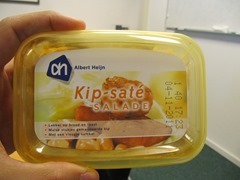
The following day was the day of the Antwerp concert. Nothing out of the ordinary. A short lovely lunch in Jeroen’s workplace, where I usually come across interesting things. So you probably all already know that the nice Dutch people are well in the habit of populating bread with strange materials. How about this?
IMG_3663

This is a chicken satay spread. Yes. You know that dish you sometimes order in Thai restaurants? Good. Now instead of it being served warm, think of it being served cold; and instead of it being served on rice or noodles, think of it being spread onto a slice of bread.

Does it make any sense to you?

To me it doesn’t. I was astonished. Puzzled, I asked—“what’s next? a fillet mignon spread?”, only to be presented with another spread titled “American Fillet”, which supposedly is exactly what I was “looking for”.

Insane.

A couple of hours later, we went to the train station to catch the train to Antwerp—some one hour and a half away from Delft, connecting in Rotterdam (which is where all bloody Dutch trains connect).


If you ask a Dutch person “how do we know that we crossed the border from The Netherlands to Belgium?”, the reply will be something along the line of “it’s when things start looking grey, boring, depressing and cold”. Is it? Well, perhaps. I can see how one would reach that conclusion. Not too long after we crossed the virtual border to Belgium, I fell asleep.

When Douglas Adams’ “Life, the Universe and Everything” was being published in the USA, it couldn’t pass censorship due to certain swearwords appearing in the text. There is a short paragraph in the book discussing the “most offensive word in the universe”: the original text had the word “Fuck” there, but in order to pass censorship in the USA, Adams chose to replace it with the word “Belgium”.

This country doesn’t seem to be receiving much credit from the world, lets put it that way.

On February 2011, Belgium broke the world record for a sovereign state not having a functioning elected government—a record that was previously held by Iraq. Something strange is going on in this country.

Arriving at Antwerp’s central station, the first thing you notify about it is that it is big. How big? Really big. It spans four levels—two of them underground—serving local, inter-city and international trains. Train travellers in Europe are very likely to pass through this station when crossing western Europe in any direction.

Just as this train station is big, it is also beautiful. Newsweek has rated this train station to be the “4th greatest train station in the world” back in 2009. Do a “Google Images” search on it; you won’t regret it.

Still, something was missing in this station. It’s called “life”. It was about rush hour, and the station was almost empty of people, which gave it all kind of an eerie look. It was also strange to find out that, during what one would deem to be “rush hour”, there’s no working information booth whatsoever. Signage being confusing at times, we decided to go for a bite before finding out for sure how to get to the venue (we had a general idea).

Stepping into a deli in the train station, I got the very same feeling about Antwerp as I got last time I was here, one year ago. It appears to be… how to call it… lifeless. Perhaps I got this feeling because a day prior I was in one of the world’s most liveliest cities—Paris; but still, I couldn’t avoid that feeling. You get that feeling just looking at people’s faces. There’s a great deal of depression there. Tiredness. Exhaustion. Greyness. People seem to be out of place, quiet, shy. Looking down. As if attempting to not be seen.

Boring, too. Apparently, people in the deli were so bored out of their asses, that when Jeroen asked them what’s the best way to get from the central train station to the venue, it sparked a discussion (between the deli’s workers and a few locals who happened to be dining there) that lasted more than half an hour about the best way to get there. And it’s not like there’s a million of ways to do the trip; as the crow flies, the distance between the station and the venue is 3km. Walking fast, that’s a 40 minutes walk. But still, the very presentation of such troubling puzzle appeared to have injected life into people.

Bah. I missed Paris.

Trying to find our way to the tram (which is also called “metro” there) through confusing signage, we finally made it to the correct platform, only to find that the “subway” (or “tram”) consists basically on one small carriage that, had it not contained people, you’d be 100% convinced that it is used to transport goats from one field to another. More depressing carriages I have only seen in Poland last year, where I had the pleasure of being transported in a metal box that looked more suitable for transporting the manure of horses with balance problems, than humans.

As it was close to show time, it was crowded as hell, too. It’s about 5 minutes tram ride that feel like 50; eventually, we arrived at a station so conveniently named “Sport” and were happy to be ejected of this cattle transporter. The venue, Sportpaleis, was right there.


Last year, the tour made a stop in Antwerp and performed in a venue called “Lotto Arena”. This time, the venue was the Sportpaleis; that explains my astonishment when I existed the train station and found out that, what the heck, that’s exactly where the concert took place last year. Turns out that the Lotto Arena and the Sportpaleis are adjacent to each other. The Sportpaleis is the bigger one.

The venue’s reception area was far from being inviting. First of all it was jam-packed with people smelling of beer, and with beer smelling of people. Toilets on the premises are not free—that’s €0.40 per visit. Well, it is a sports arena after all so expecting much more would probably be a mistake anyway.

Tickets: 5th row all the way to the left. Bummer. Lane & Katrina, my friends from Flagstaff, Arizona were there too after having taken the train from Paris. Now there’s an interesting couple for you, sharing an amazing life story, brilliant people I’m always happy to see. In Paris, Katrina promised to provide me with a tasty gift in Antwerp. She did.

So there’s this guy named Pierre Hermé. I have never heard of him before and therefore should feel ashamed. This guy is a French pastry chef who is extremely famous for his macaroons. According to Wikipedia, the French Vogue magazine described him as the “Picasso of Pastry”. Katrina, then, thought that it would be a great idea to provide me with a sample of this guy’s macaroons—a thought that was very much called for. This sweetheart carried a macaroon for me all the way from Paris.

Right from the first bite, you feel that macaroons should, by law, be standardized for greater size. At least premium macaroons as this one. It was so good. Just so good, feeling as if exactly twelve angels are dancing inside your mouth. I am therefore deeply indebted to this wonderful couple, and will, obviously, pay a visit to this guy’s pastry shop next time I’m in Paris.

The concert started at 8:00pm. As the last train from Antwerp back to Delft was scheduled for 10:00pm, we already knew we’re not going to stay for Bob Dylan’s show.


Well we obviously weren’t in Paris anymore. Even though the performance, by itself, was very good featuring further elaborations of songs all of which have been played before—one thing was sorely missing and it was the audience. I’m not sure how many people were there in the audience during the Antwerp concert—well, it’s a large venue and not many empty seats were left unoccupied—but, audience-wise, it was as if the audience wasn’t there. Again, I might have had that impression because two nights prior I was a part of the best audience so far, in Paris.

The audience in Antwerp seemed to be reserved and not much responding to the great performance they were witnessing. I would attribute this to the general atmosphere you get when you spend time in Belgium… some sort of indifference. It seemed to be very hard to excite these people with anything, at least that’s the impression I got.

Set-list-wise, no surprises there. Privateering was the only unreleased song to be played, Brothers in Arms and Speedway at Nazareth switched places and, as customary these days, So Far Away ended the show. Exciting solos during Hill Farmers Blues—I have to say, way too exciting for the audience that had the privilege to witness them. The only times when the audience seemed to have wielded noises close to being interesting were at the beginning of Brothers in Arms and the end of Speedway at Nazareth. Well thanks Belgium.


As soon as the encore was done, we stormed out of the venue. Nobody wanted to miss the train back to Delft, as it would mean spending a night in this lonely city.

Arriving back to Antwerp Centraal by tram, we had to actually leave the station and re-enter it. Bizarre design, I’d say: from the metro, you’re ejected to the station’s parking lot, then have to find your way (through insane signage) back to the station after practically exiting it. Upon re-entry, I looked around and then I figured something interesting about this place.

The surrounding of Antwerp Centraal, in the dark, is the perfect location for filming a murder scene. There’s everything: extremely high ceilings; dark, grey colours; vast emptiness; buildings and business around the station, looking as if they’re just waiting to be demolished.

Empty.

Empty.

So empty.

Brrrrrrrrrrrrrrrrrrrrr. I was happy to be back in The Netherlands.

Late night sleep after popping some Bob Dylan tunes on Jeroen’s stereo, and off I woke up ready for the last concert (for me) in the tour—this time, close to “home”: Rotterdam, some 15 minutes train ride from Delft.

Isaac